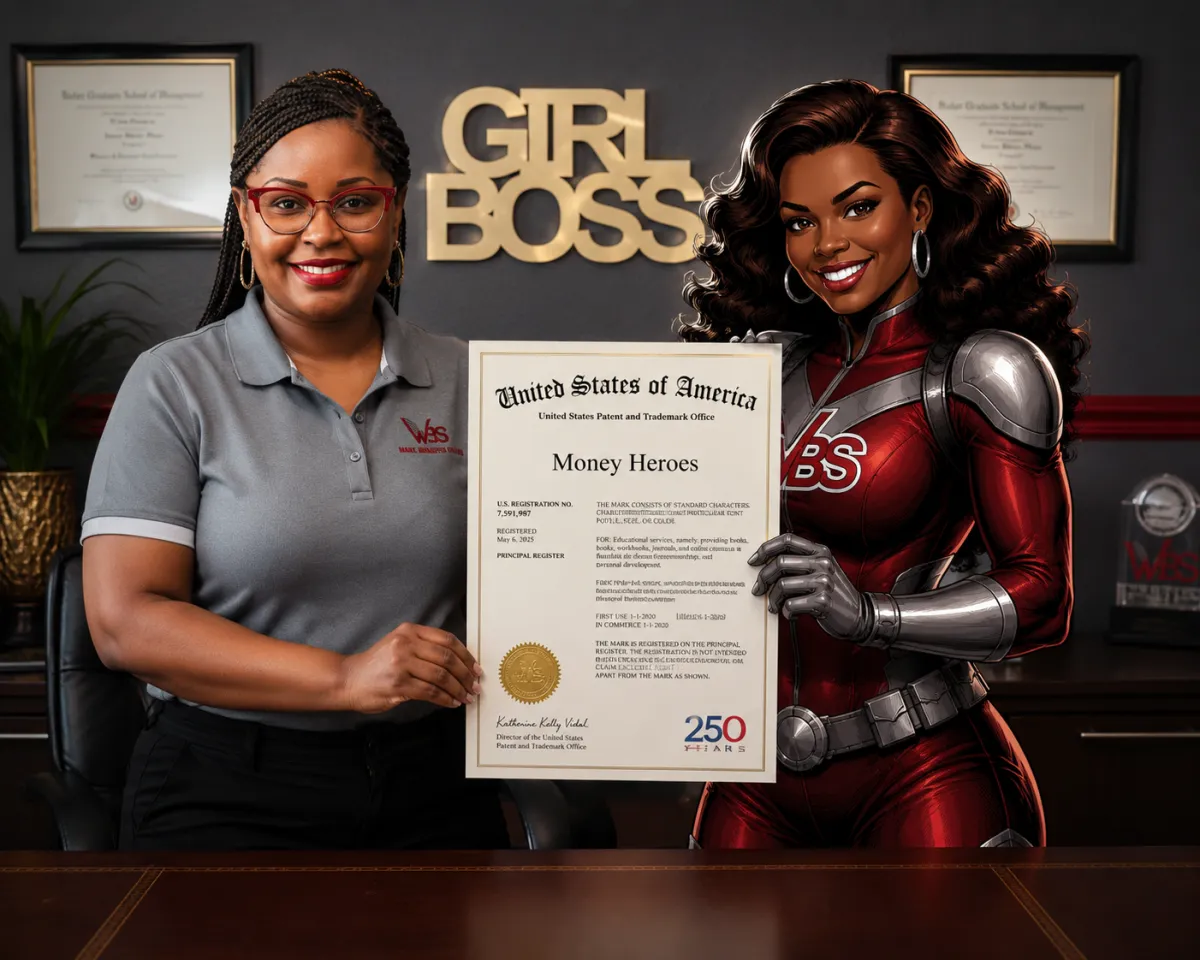
Why I Trademarked Money Heroes® and Why Ownership Matters
By Donisha Wright, MBA
Founder of Money Heroes®
When I first created Money Heroes®, it was more than just a business idea. It was a mission.
I wanted to create a financial literacy brand that would help children, teens, and adults develop the money skills needed to build stronger financial futures. What started as an educational concept quickly grew into books, educational materials, merchandise, workshops, and long-term expansion plans.
As the brand grew, I realized that if I was serious about building a lasting legacy, I needed to protect it.
That's why I pursued a federal trademark for Money Heroes®.
Why I Chose to Trademark Money Heroes®
Building a brand takes time, creativity, and significant investment.
Since launching Money Heroes® in August 2025, I have spent countless hours:
Developing content
Creating characters and storylines
Designing products
Building a website and social media presence
Marketing the brand
Establishing credibility in the community
Without trademark protection, another person could potentially create a similar brand, causing confusion among customers and diluting everything I worked to build.
Registering the trademark gives me exclusive rights to use the Money Heroes® name in connection with the goods and services covered by the registration.
Most importantly, it protects the brand as it continues to expand.
Thinking Beyond Today
Many entrepreneurs focus only on their current business operations.
I took a different approach.
When I created Money Heroes®, I wasn't thinking about where it would be in six months. I was thinking about where it could be in five, ten, or twenty years.
Future plans include:
Financial literacy books
School and community programs
Workshops and speaking engagements
Branded merchandise
Digital learning resources
Licensing opportunities
Media and entertainment projects
Trademark protection helps ensure that future growth remains connected to the brand I created.
Why Money Heroes® Is Owned by My S Corporation
One strategic decision I made was to have the Money Heroes® trademark owned by my S Corporation rather than personally.
By having the trademark owned by my S Corporation, the Money Heroes® brand becomes a corporate asset that can be protected, valued, licensed, transferred, or inherited as part of the company's long-term growth and succession strategy. As the brand continues to grow through books, educational materials, merchandise, workshops, licensing opportunities, and future media projects, ownership through the corporation helps create a stronger foundation for expansion while preserving the value being built.
Another strategic decision I made was separating the ownership of the Money Heroes® intellectual property from the retail sale of certain tangible products. While Money Heroes® is owned by my S Corporation, certain branded merchandise and physical products are sold through my other company, Random Stuff Resell LLC. Random Stuff Resell currently serves as the exclusive retailer for Money Heroes® merchandise. This was a deliberate business decision designed to support the growth of the brand while allowing each company to focus on its primary purpose.
Many small business owners don't realize there can be significant advantages to structuring ownership this way.
1. The Trademark Becomes a Business Asset
Because the trademark is owned by the company, it becomes an asset of the business rather than a personal asset.
This can increase the overall value of the company and may become important if the business is ever:
Sold
Merged
Licensed
Franchised
Valued for financing or investment purposes
A strong brand can become one of a company's most valuable assets. In some businesses, intellectual property and brand recognition are worth more than the physical assets themselves.
2. Cleaner Separation Between Personal and Business Assets
One of the primary purposes of an S Corporation is creating separation between personal and business affairs.
Having the trademark owned by the corporation helps maintain that separation by ensuring that intellectual property is held by the business entity that develops, markets, and uses the brand.
This structure also helps support corporate formalities and reinforces the distinction between personal assets and business assets.
3. Easier Growth and Expansion
As Money Heroes® expands into new products, services, partnerships, licensing agreements, and educational programs, having the trademark owned by the business provides a clear ownership structure.
Potential partners, vendors, investors, and licensors often prefer working directly with the business entity that owns the intellectual property rather than an individual owner.
4. Building a Legacy for My Children
As a mother of three adult children and one 17-year-old (thank you Lord, I’m almost done), I don't just think about building wealth, I think about preserving it for the next generation.
Another reason I chose to have Money Heroes® owned by my S Corporation rather than personally is because it creates a cleaner path for succession and inheritance planning.
Because an S Corporation is owned through shares of stock, ownership interests can be divided into transferable shares rather than requiring the underlying business assets to be physically divided among heirs. This structure can make it easier to transfer ownership interests through an estate plan while allowing the business to continue operating as a single entity.
Rather than attempting to split intellectual property, contracts, branding rights, inventory, or other business assets among multiple beneficiaries, ownership can often be transferred through stock ownership in the corporation.
Potential benefits may include:
Easier succession planning
Fractional ownership among heirs
Greater continuity of business operations
Reduced disruption to customers and business partners
Simplified transfer of ownership interests
More flexibility when coordinating with estate planning professionals
It is important to understand that corporate ownership alone does not automatically avoid probate. Depending on how an estate is structured, ownership interests may still pass through probate or other estate administration processes.
Probate costs vary by state and the complexity of the estate, but many estimates place total probate-related costs between 3% and 7% of the estate's value when attorney fees, court costs, executor fees, and administrative expenses are considered.
For this reason, business owners should consider discussing succession planning, trusts, beneficiary designations, and ownership transfers with a qualified estate planning attorney. Every family's situation is different, and a professional can help determine the most appropriate strategy for protecting both family and business interests.
My goal has never been simply to create another business that disappears when I do.
My goal is to build something that can outlive me.
Why Protecting Your Brand Matters in the Digital Age
Today's entrepreneurs have more opportunities than ever to reach customers through online marketplaces and digital platforms. However, the internet has also made it easier for original ideas, designs, and branding to be copied and distributed without permission.
Over the years, various online marketplaces and platforms—including Shein, Temu, Etsy sellers, print-on-demand stores, and other e-commerce websites—have faced allegations from independent creators, artists, designers, and small business owners regarding intellectual property infringement and unauthorized use of original works. While each claim is unique and allegations do not necessarily indicate wrongdoing by the platform itself, these situations highlight the challenges creators face when protecting their brands and intellectual property online.
If you've ever spent months building a brand, creating content, designing products, and investing your hard-earned money into marketing, the idea of someone copying your work overnight can raise your blood pressure faster than an IRS notice.
In a world where a design, logo, or brand concept can be copied and shared globally in a matter of hours, protecting your intellectual property is no longer just a legal consideration, it is an important business strategy. (Especially when it seems like everybody has a Cricut machine and a side hustle these days)
My Trademark Journey: What I Learned Along the Way
After deciding to protect the Money Heroes® brand, I submitted my trademark application on November 18, 2025.
Like many entrepreneurs, I debated whether to hire an attorney or file the application myself. Ultimately, I chose to complete the application on my own. While this allowed me to save money on legal fees, it also meant I accepted the risk that any mistakes could delay the process or potentially require me to start over.
At the time I filed, the application fee was approximately $350 per class, so accuracy was important. I filed under Class 16 (printed educational materials and books) and Class 25 (apparel).
Beware of Trademark Solicitation Scams
One thing that surprised me was how quickly I began receiving emails and phone calls after filing my application.
The USPTO warns applicants that trademark applications become public record, which means third parties can access your information and contact you.
Almost immediately, I started receiving messages from companies offering trademark-related services.
One example was an email from:
The email offered free trademark status alerts and other services related to my application.
Fortunately, I had already researched the trademark process and knew that trademark applications often take several months to move through the review process. Because of that, I wasn't looking for anyone to "expedite" my application or provide monitoring services.
A quick internet search revealed numerous complaints and warnings from other applicants who believed similar communications were misleading or deceptive.
I also received a phone call from someone claiming to be affiliated with the USPTO. The caller requested my email address in order to discuss my application.
That immediately raised a red flag.
My email address was already included on the trademark application itself, so there was no reason for a legitimate USPTO representative to need me to provide it again.
Let's just say that conversation ended very quickly.
How I Protected Myself
Throughout the process, I followed a few simple rules:
I verified all communications carefully.
I checked email addresses before clicking any links.
I made sure official emails came from domains ending in uspto.gov.
I researched companies before responding to solicitations.
I ignored pressure tactics and offers that seemed unnecessary.
I relied on information directly from the USPTO whenever possible.
Most importantly, I took my time.
Research Was My Best Friend
As an accountant, I have a hard time clicking "Submit" on anything that costs hundreds of dollars without knowing exactly what I'm signing up for. Rather than rushing through the application, I researched each section as I completed it.
I spent time understanding:
Trademark classifications
Goods and services descriptions
Ownership requirements
Filing requirements
USPTO guidance and resources
The process required patience, but it also gave me a deeper understanding of how intellectual property protection works.
Timeline of My Trademark Application
My trademark journey progressed as follows:
November 18, 2025
Trademark application filed for Money Heroes®.
April 22, 2026
Notice of Publication issued.
The publication period allows third parties an opportunity to oppose the registration if they believe the trademark conflicts with their rights.
June 16, 2026
Registration Certificate issued.
From application to registration, the process took approximately seven months, which was consistent with the general timelines I had researched before filing.
Was Filing Without an Attorney the Right Choice?
For me, the answer was yes. My research skills are strong, and I don't mind reading instructions that most people skip. However, if legal paperwork makes your eye twitch, hiring an attorney may be money well spent.
However, that doesn't mean it's the right choice for everyone.
My application was relatively straightforward, and I was willing to invest significant time researching the requirements before submitting it.
For business owners with more complex situations, multiple trademarks, licensing arrangements, international expansion plans, or concerns about potential conflicts, working with a trademark attorney may be well worth the investment.
My Biggest Takeaway
The biggest lesson I learned is that protecting your brand doesn't end when you click "Submit."
You must remain vigilant throughout the process.
Scammers know that trademark applications are public information, and they often target business owners who are unfamiliar with the process.
Taking the time to educate yourself, verify communications, and proceed carefully can save you money, frustration, and potentially much bigger problems down the road.
Receiving my registration certificate on June 16, 2026, was a proud moment—not just because Money Heroes® was officially registered, but because it represented months of research, patience, and commitment to protecting a vision I believe in.
Is a Trademark Worth It?
For many business owners, the answer is yes.
You've invested time, money, and energy into building your reputation. A trademark helps protect that investment and provides a foundation for future growth.
Your logo can be redesigned.
Your website can be updated.
Your marketing can change.
But your brand identity is what customers remember.
Protecting it may be one of the smartest long-term business decisions you make.
Final Thoughts
A trademark is more than a legal filing. It’s an investment in your business's future.
Whether you're launching a new company, developing a product line, creating educational content, or building a recognizable brand, protecting your intellectual property should be part of your business strategy.
Before spending thousands on marketing, ask yourself:
"Have I protected the name I'm promoting?"
The answer could save you significant time, money, and frustration down the road.
Anybody can start a business. (Trust me, I have three, and only one is consistently profitable.) Building something worth protecting is a different story.
Disclaimer: The information in this article reflects my personal experience and opinions as a business owner. It is provided for educational purposes only and should not be considered legal, tax, or estate planning advice. Please consult with a qualified attorney, CPA, or other licensed professional regarding your specific situation.
Need Help Growing and Protecting Your Business?
Whether you're launching a new business, cleaning up your books, evaluating an S Corporation election, or looking for guidance on building a stronger financial foundation, Wright Bookkeeping & Financial Services is here to help.
Visit WrightBS.com to learn more about our bookkeeping, payroll, tax, and consulting services.