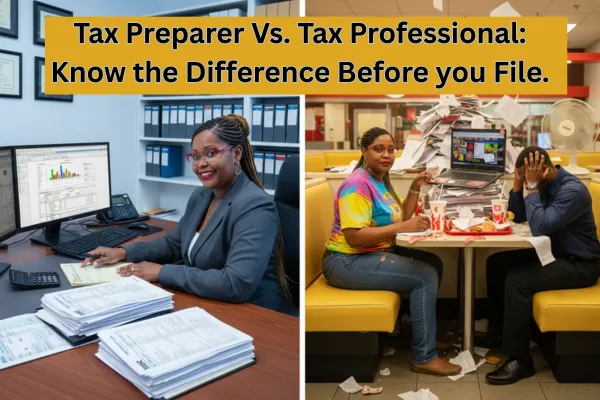
Tax Preparer vs. Tax Professional: Not Everybody With a Laptop Should Be Doing Your Taxes
Let’s have a quick heart-to-heart.
Every tax season, people start asking the same question:
“Do you know someone who can do taxes?”
Now listen… just because someone has tax software and a printer does not mean they are qualified to handle your finances. The tax world has a wide range of people preparing returns , from highly trained professionals to folks who learned taxes last week on YouTube.
Every tax preparer is not a tax professional.
And if you don’t know the difference, you could end up owing the IRS money while the person who prepared your return has mysteriously disappeared until next January.
Let’s talk about it.
What Is a Tax Preparer?
A tax preparer is simply someone who prepares tax returns for pay.
That’s it.
There is no universal license required to prepare taxes in many cases. As long as someone obtains a Preparer Tax Identification Number (PTIN) from the IRS, they can legally prepare tax returns for clients.
That means a tax preparer could be:
A seasonal employee at a tax chain
Someone doing taxes as a side hustle
A bookkeeper who also prepares returns
A person who bought tax software and decided to “start a tax business”
Now don’t misunderstand, some tax preparers are excellent and knowledgeable.
But the truth is the experience level can vary widely, which is why it’s important to know who you're trusting with your financial life.
Because once your return is filed, the IRS is not calling the preparer… they’re calling you.
What Is a Tax Professional?
A tax professional typically has formal training, credentials, and continuing education requirements.
These professionals have invested time learning the tax code, IRS procedures, and compliance rules.
Examples include:
Certified Public Accountants (CPAs)
CPAs are licensed by state boards of accountancy and must complete ongoing education to maintain their license.
They often handle complex financial matters including tax planning, audits, and financial reporting.
Enrolled Agents (EAs)
Enrolled Agents are licensed directly by the IRS and specialize in taxation.
Tax Attorneys
Tax attorneys specialize in tax law and can represent clients in court when legal tax disputes arise.
CPA's, EA's, and Tax Attorneys all have the authority to represent taxpayers before the IRS, which means they can represent you during audits, collections, or other tax issues.
AFTR Certified Preparers
Some preparers participate in the IRS Annual Filing Season Program, which includes completing continuing education each year.
One of the main requirements of this program is completing the Annual Federal Tax Refresher (AFTR).
We’ll talk about that next.
The IRS Annual Filing Season Program (AFSP) and AFTR
The IRS created the Annual Filing Season Program (AFSP) to encourage tax preparers to stay educated on current tax laws.
Because if there’s one thing the IRS loves to do, it’s change the rules every year.
A key component of this program is the Annual Federal Tax Refresher (AFTR).
The AFTR course includes:
Updates on current federal tax law
Filing requirements
Due diligence rules
Ethics training
A final exam
Preparers who complete the required continuing education and pass the AFTR receive a Record of Completion from the IRS.
This allows them to be listed in the IRS Directory of Federal Tax Return Preparers with Credentials and Select Qualifications.
If you want to verify someone’s credentials, you can search the directory here:
https://irs.treasury.gov/rpo/rpo.jsf
Let’s Talk About Ghost Preparers
Now this one right here… this is where folks get into trouble.
A ghost preparer is someone who prepares your tax return but refuses to sign it as the paid preparer.
They might say things like:
“Just sign here and say you prepared it.”
“I’m just helping you.”
“You submit it yourself.”
Absolutely not. No sir!
The IRS requires paid preparers to sign the tax return and include their PTIN.
Ghost preparers avoid signing returns because they are often doing something shady.
Common ghost preparer schemes include:
Claiming fake tax credits
Making up deductions
Creating businesses that do not exist
Reporting income that was never earned
The problem is when the IRS discovers the fraud, you are the one responsible for it .
Not the ghost preparer.
And guess what happens next?
That phone number suddenly doesn’t work anymore.
Be Careful With Refund-Based Fees
Another big warning sign is when a preparer says their fee will be based on how large your refund is.
That should make you pause immediately.
When someone’s pay depends on the size of your refund, it creates a huge incentive to manipulate the numbers.
A legitimate preparer typically charges:
A flat fee
A form-based fee (**most common)
An hourly rate (usually based on complexity)
But tying fees to refunds? That’s a risky setup that can lead to inflated or fraudulent returns.

Watch Out for Fake Income or Fake Businesses
This one has become extremely common.
Some preparers create fictional businesses or false income in order to qualify taxpayers for credits.
You might hear things like:
“Let’s add a small business so you qualify for this credit.”
Or
“I’m going to put you down as self-employed so your refund increases.”
Sounds good in the moment… until the IRS sends a letter two years later asking questions.
Now you’re trying to explain a business you never actually owned.
That’s not a situation you want to be in.
Your Refund Should Go to YOU
Here’s another simple rule.
Your refund should be deposited into your bank account unless you are using legitimate third-party service to facilitate tax refunds and to pay for tax preparation fees. They are essentially a "middleman" that processes the payment between the IRS and your bank account. Examples are Santa Barbara Tax Products Group (SBTPG), Republic Bank & Trust Company, Refund Advantage, EPS, etc.
Not the preparer’s.
Some dishonest preparers route refunds through their accounts so they can:
Take a larger cut
Charge hidden fees
Skim money off the refund
If someone insists on controlling where your refund goes, that’s another warning sign.
How to Protect Yourself During Tax Season
A few simple steps can save you a lot of headaches.
Before hiring a tax preparer:
✔ Ask if they have a PTIN
✔ Check their credentials in the IRS directory
✔ Ask about their experience and training
✔ Review how they charge their fees
✔ Make sure they sign your tax return
✔ Confirm your refund goes directly to your bank account
And most important—review your tax return before signing it!
Don’t sign anything you don’t understand.
Final Thoughts
Taxes are one of those areas where trying to cut corners can cost you big later.
The person preparing your tax return is handling:
Your Social Security number
Your income information
Your financial records
That’s not something you hand over to the first person with tax software and a folding table.
Take a few minutes to check credentials, ask questions, and make sure you’re working with someone who is qualified.
Because when the IRS has questions…they are calling you, not the person who “hooked you up.”