
Should You Elect S-Corp Status?
Should You Elect S-Corp Status?
What It Is, Who It Helps, and How to Know If It’s Right for Your Business
Every tax season, this question comes up:
“Should I be an S-Corp?”
And almost every time, the person asking has heard one of the following:
“You’ll save thousands in taxes.”
“My friend switched and paid way less.”
“TikTok said I need to be an S-Corp.”
Let’s slow that down.
An S-Corporation election can be powerful. It can absolutely reduce taxes when structured correctly. But it is not magic, and it is not right for every business.
This week inside Wright Bookkeeping & Financial Services, I’ve been working on multiple S-Corp evaluations and elections for clients and I want to walk you through what it actually means, how it works, and how to determine whether it makes sense for you.
First, clarity.
An S-Corporation is not a business entity type.
It is a tax election made with the IRS (Form 2553) that changes how your business is taxed.
You can elect S-Corp status if you are:
An LLC
A Corporation
The election tells the IRS:
“Instead of taxing me like a sole proprietor or traditional corporation, I want to be taxed under Subchapter S rules.”
That changes how your income is split and taxed.
How S-Corp Taxation Works (In Plain English)
If you’re a single-member LLC (SMLLC) without S-Corp status, the IRS treats you like a sole proprietor.
That means:
All profit is subject to income tax. (Not how much money you have left in the bank at the end of the year)
All profit is subject to self-employment tax (15.3%)
Self-employment tax is what covers Social Security and Medicare.
Here’s where S-Corp status becomes attractive.
With an S-Corp:
You pay yourself a reasonable salary
That salary is subject to payroll taxes
The remaining profit is taken as a distribution
Distributions are not subject to self-employment tax
Same business.
Same revenue.
Different tax structure.
That’s where potential savings live.
Example: Real-World Scenario
Let’s say your business nets $100,000 in profit.
Without S-Corp:
You pay self-employment tax on the full $100,000.
With S-Corp:
You pay yourself a reasonable salary of $70,000.
You take $30,000 as distributions.
Self-employment tax applies only to the $70,000 salary.
That can mean thousands saved in payroll taxes.
Now here’s the part people don’t talk about:
You must run payroll.
You must file payroll tax returns.
You must file an 1120-S corporate return.
You must maintain clean books.
You must follow “reasonable compensation” rules.
This is not a DIY, wing-it situation.
What I’ve Been Working On Recently
Behind the scenes last month, I’ve:
Helped a consultant transition from sole proprietor to S-Corp after crossing consistent $90K net income
Reviewed a business that should NOT elect S-Corp yet because revenue is too inconsistent and too low
Advised a client to delay election until Q1 next year for strategic timing
This is why blanket advice is dangerous.
The right move depends on:
Profit level
Stability
Industry
Owner involvement
Payroll capacity
Long-term growth plans
The Hidden Responsibilities of an S-Corp
Here’s the honest part:
Electing S-Corp status increases compliance.
You must:
Run payroll regularly
File quarterly payroll reports
Pay payroll taxes on time
File Forms 940/941
File state unemployment reports (if applicable)
Issue yourself a W-2
File Form 1120-S annually (Costs vary based on complexity, with basic returns often starting around $800–$1,200, while complex returns can exceed $3,000)
Maintain corporate formalities
It’s not complicated, but it requires discipline.
And discipline in bookkeeping is what keeps you safe.
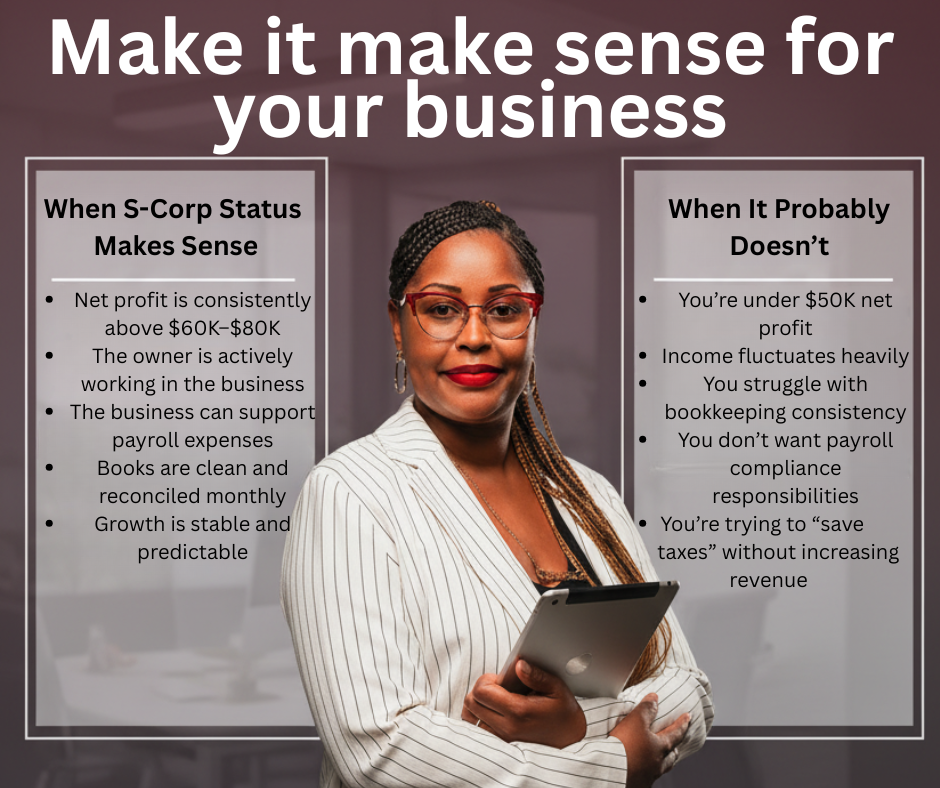
S-Corp Readiness Assessment
Below is a self-evaluation form you can use to determine whether this election might make sense for your business.
The Real Benefit of S-Corp Status
It’s not just about saving money.
It forces you to:
Pay yourself consistently
Treat your business like a real company
Implement payroll discipline
Maintain clean financial records
Plan taxes strategically
In other words — it professionalizes your operation.
And professional businesses grow faster.
Common Mistakes I See
Let me be blunt.
Here’s what gets business owners into trouble:
Electing S-Corp but never running payroll
Paying themselves only distributions
Guessing at salary amounts
Not filing payroll reports
Missing election deadlines
Electing too early
Electing too late
An S-Corp is powerful — but only when implemented correctly.
Timing Matters
The S-Corp election must generally be filed:
Within 75 days of the start of the tax year
ORBy March 15 for existing businesses
Late elections may be possible — but they require proper handling.
This is not something you want rejected because of a paperwork mistake.
How Wright Bookkeeping Helps
When we handle an S-Corp election, we don’t just file Form 2553.
We:
Evaluate whether it makes financial sense
Calculate projected tax savings
Determine reasonable salary
Set up payroll systems
Ensure bookkeeping is structured properly
Provide ongoing compliance support
File corporate returns accurately
We don’t just flip a switch.
We build the structure around it.
Final Thought
S-Corp status is not a tax hack.
It’s a strategic decision.
If your business is growing and generating consistent profit, it may be one of the smartest moves you make.
If your foundation isn’t stable yet, the smartest move may be strengthening your books first.
Either way — guessing is expensive.
Ready to Find Out If S-Corp Status Is Right for You?
If you’re a small or medium business owner and you want clarity instead of internet opinions, let’s evaluate your numbers properly.
Book a consultation and we’ll:
Review your profit
Estimate potential tax savings
Determine reasonable salary
Assess compliance readiness
Map out next steps
Your business deserves strategy not guesswork.
Schedule your S-Corp Evaluation today.