Can a Business Accept Donations? What Every Business Owner Needs to Know
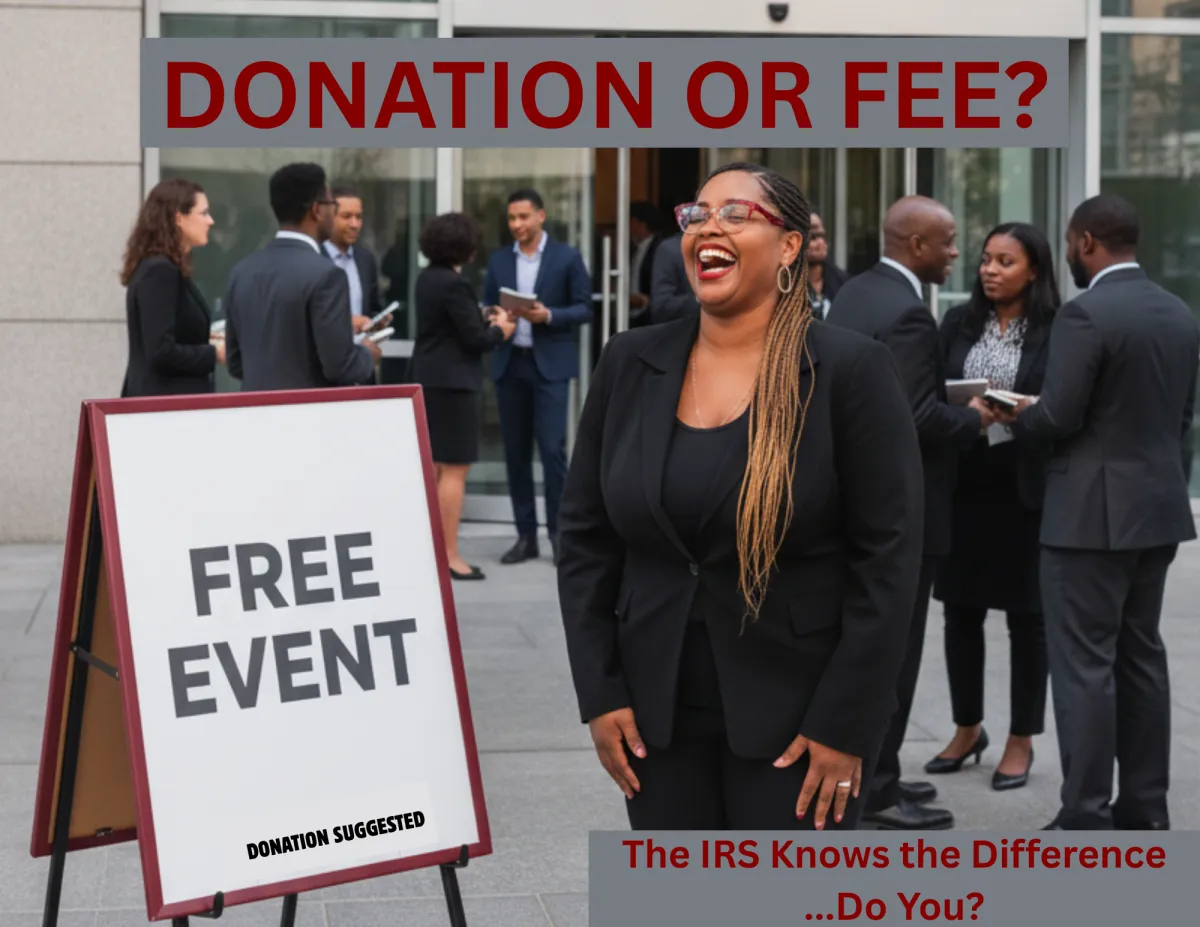
"Wait...I thought this event was free."
That was my first thought when I attended an event in June.
The flyer advertised it as a free event, but when I arrived, I learned that attendees who hadn't pre-registered were required to make a donation before entering. To be fair, the information was on the flyer. I simply overlooked the fine print.
My eyes apparently skipped right over it. Lesson learned: read the whole flyer...even the part your brain insists is optional.
Rather than argue about it, I paid the minimal donation. Honestly, I'd rather hand over a few dollars than end up on another email marketing list.
The experience reminded me of a question I hear from business owners from time to time:
Can a for-profit business legally ask people for donations?
The answer is yes, but there are important tax, bookkeeping, and legal differences between a donation, a fee, and a charitable contribution that every business owner should understand.
This blog isn't about whether that particular event was right or wrong. It simply sparked my curiosity about how donations work for businesses and reminded me how often this topic is misunderstood.
Let's clear up the confusion.
Can a For-Profit Business Accept Donations?
Many people assume the word "donation" automatically means the money is going to a nonprofit organization.
That's one of the biggest misconceptions I see.
A for-profit business may legally ask customers or supporters for voluntary gifts or donations, provided it is truthful about what it's collecting and doesn't misrepresent itself as a tax-exempt charity.
Businesses sometimes request donations to:
Help launch a new business
Offset operating expenses
Fund community projects
Recover after a natural disaster
Support a business-related cause
Allow customers to voluntarily support the business
Generally speaking, there is no federal law that prohibits a for-profit business from accepting voluntary donations, provided the business complies with applicable consumer protection, tax, and fraud laws.
However, the name you give the payment doesn't determine its tax treatment. The IRS looks at the nature of the transaction, and your bookkeeping should reflect that.
Donation vs. Fee
One of the easiest ways to understand the difference is to ask one simple question:
Could I say "no" and still receive the product or service?
If the answer is yes, you're probably looking at a donation.
If the answer is no, it's probably a fee.
Simply calling a payment a donation doesn't automatically make it one.
The IRS and state tax agencies generally look at what actually happened, not just the label used.
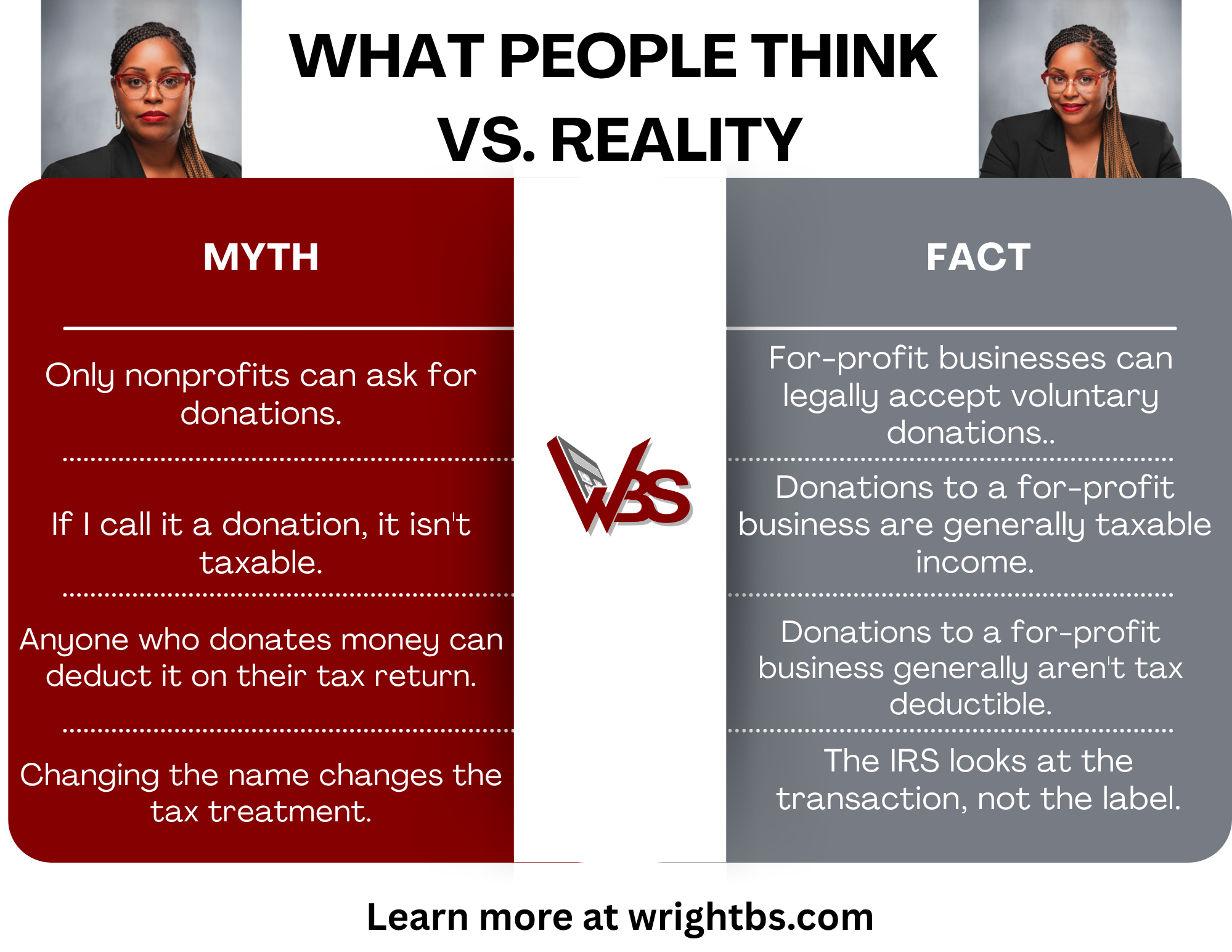
Myth vs. Fact
How Does the IRS Treat Donations Received by a Business?
This is where many business owners get surprised.
Just because your customer intended the payment to be a donation doesn't automatically mean the IRS agrees.
For most for-profit businesses, money received through donations is generally considered taxable business income.
That means the money typically:
Must be included in your business income.
Should be recorded in your accounting records.
Must be reported when you file your business tax return.
In other words, simply changing the label on the payment doesn't make it tax-free.
The IRS is concerned with why the money was received—not just what the transaction was called.
What About the Person Giving the Money?
This is another area where confusion is common.
Many people assume that every donation qualifies as a charitable tax deduction.
Unfortunately, that's not the case.
If you're contributing money to a for-profit business, your payment is generally not tax-deductible as a charitable contribution.
Those tax benefits are generally reserved for organizations that have qualified for tax-exempt status, such as many 501(c)(3) organizations.
That's why transparency matters.
If your business accepts donations, clearly communicate that contributions are not tax-deductible unless you're a qualified tax-exempt organization.
Being upfront avoids confusion, builds trust with your supporters, and helps prevent unpleasant surprises during tax season.
Bookkeeper's Tip
I've seen business owners create an income account called "Donations" in QuickBooks and assume that because it has a different name, it isn't taxable.
Unfortunately, bookkeeping doesn't work that way.
If your business receives money as part of operating your business, it generally needs to be recorded properly and reported on your tax return.
Changing the account name doesn't change the tax treatment.
If you're unsure how to record donations or contributions in your accounting software, ask your accountant or bookkeeper before tax season—not after.
Trust me...it's much easier (and usually less expensive) to record it correctly the first time.
What About Crowdfunding?
Crowdfunding has become one of the most popular ways to raise money, but many business owners assume that all crowdfunding is treated the same for tax purposes.
It's not.
The tax treatment depends on why the money was raised and what contributors receive in return.
Equity or Debt Crowdfunding
With equity crowdfunding, contributors invest in the business in exchange for ownership shares. With debt crowdfunding, contributors loan money to the business with the expectation of being repaid.
In these situations, the money is generally treated as investment capital or loan proceeds, not taxable business income when received.
Reward-Based Crowdfunding
Reward-based crowdfunding is common on platforms where contributors receive something in return, such as:
A product
Merchandise
Early access
Services
Exclusive perks
Because contributors receive something of value, the money is generally treated as taxable business income.
Think of it as a sale, even if it happens before the product is delivered.
Donation-Based Crowdfunding
Donation-based crowdfunding is where many people become confused.
When a campaign is created for a personal hardship, such as medical expenses, funeral costs, disaster relief, or another personal need, and contributors receive nothing of value in return, the funds are often considered personal gifts rather than taxable income.
As TurboTax explains:
"If you or someone you know established a personal GoFundMe campaign in your name and it resulted in gifts from other people or organizations, you're likely able to consider these as personal gifts subject to gift tax laws."
However, if a business launches a donation campaign to support its operations, expansion, or expenses, the IRS will generally view those contributions differently. In most cases, funds received by a for-profit business are considered taxable business income.
The IRS focuses on the substance of the transaction, not simply the platform or the word "donation."
What Does the IRS Consider a Gift?
The IRS defines a gift as a transfer of money or property where the giver does not receive full value in return.
A gift can include:
Cash
Property
Below-market sales
Interest-free loans
Indirect transfers
For 2026, the annual federal gift tax exclusion allows an individual to give up to $19,000 per recipient each year without triggering federal gift tax reporting requirements.
Married couples can combine their annual exclusions to give up to $38,000 per recipient annually.
One important point to remember:
These rules generally apply to the person making the gift, not the person receiving it.
Nonprofits Earn Their Tax Benefits
When people hear the word "donation," they often picture a charity.
While many nonprofits do accept donations, becoming a qualified 501(c)(3) organization isn't automatic.
Organizations often spend months preparing applications, organizing governing documents, and meeting IRS requirements before receiving tax-exempt status. Even after approval, they must continue complying with ongoing federal and state reporting requirements to maintain that status.
That's why it's important not to confuse a nonprofit fundraising campaign with a for-profit business accepting voluntary contributions.
The tax rules are different.
The reporting requirements are different.
And the tax benefits for donors are different.
How Can You Verify a Nonprofit?
If an organization tells you your contribution is tax-deductible, don't just take their word for it.
The IRS provides a free online search tool where you can verify whether an organization qualifies as a tax-exempt nonprofit.
IRS Tax Exempt Organization Search:
A quick search can help you confirm whether an organization is eligible to receive tax-deductible charitable contributions.
What About Texas?
Texas is a little different from many other states.
Unlike states that require nearly every charitable organization to register before soliciting donations, Texas does not have one broad charitable solicitation registration law covering all nonprofits.
Instead, Texas has several specialized solicitation laws that apply to certain organizations and fundraising activities.
These include:
Veterans Solicitation Act (VSA)
Organizations covered by this law must register and file the appropriate documentation with the Texas Secretary of State.
Public Safety Solicitation Act (PSSA)
This law regulates organizations raising money for public safety purposes or using certain public safety terminology.
Law Enforcement Telephone Solicitation Act (LETSA)
This law governs telephone fundraising conducted on behalf of law enforcement organizations.
While these laws generally apply to specific situations, they highlight the importance of understanding the rules before asking the public for money.
Red Flags to Watch For 🚩
Not every request for a donation is a cause for concern, but it's always wise to pay attention.
Consider asking additional questions if you notice any of the following:
The organization claims your payment is tax-deductible but can't verify its nonprofit status.
You're told it's a "donation," but everyone is required to pay the exact same amount.
The organization refuses to explain where the money will be used.
You're pressured into contributing immediately.
They become defensive when you ask reasonable questions.
As consumers, it's okay to ask questions before opening your wallet.
What If the "Donation" Is Really Required?
Remember my experience at the beginning of this article?
I paid the minimal donation and went on to enjoy the event.
Again, this blog isn't about whether that particular event handled things correctly. It simply reminded me how easily people can confuse the words donation, fee, and admission.
If an organization refuses to provide admission, products, or services unless you pay a specific amount, the payment may be viewed as a required fee rather than a voluntary donation.
Depending on the circumstances, that distinction could have consumer protection and tax implications.
If you believe a business is misleading consumers, you may consider filing a complaint with the Texas Attorney General's Consumer Protection Division.
In addition, mandatory charges for admission or specific services may have Texas sales tax implications, even if they're labeled as donations. The Texas Comptroller provides guidance for charitable organizations and taxable transactions.
Final Thoughts
There's nothing inherently wrong with a for-profit business asking people to support it through voluntary donations.
The key is transparency.
Business owners should clearly communicate:
Whether the payment is voluntary or required.
Whether contributors receive anything in return.
Whether the contribution is tax-deductible.
How the funds will be used.
That donations received by a for-profit business are generally treated as taxable business income.
Consumers appreciate honesty, and transparency builds trust.
As always, if you're unsure whether money received by your business should be treated as taxable income, ask your accountant or bookkeeper before tax season.
It's much easier to answer questions now than explain them during an IRS audit later.
I'd Love to Hear From You
Have you ever attended a "free" event that unexpectedly asked for a donation?
Or, as a business owner, have you ever considered accepting donations to support your business?
Share your experience in the comments below. I'd love to hear your thoughts and continue the conversation.
Disclaimer: This article is intended for educational purposes only and should not be considered legal, tax, or accounting advice. Tax laws and reporting requirements vary depending on your specific facts and circumstances. Consult a qualified tax professional or attorney regarding your individual situation before making financial or tax-related decisions.